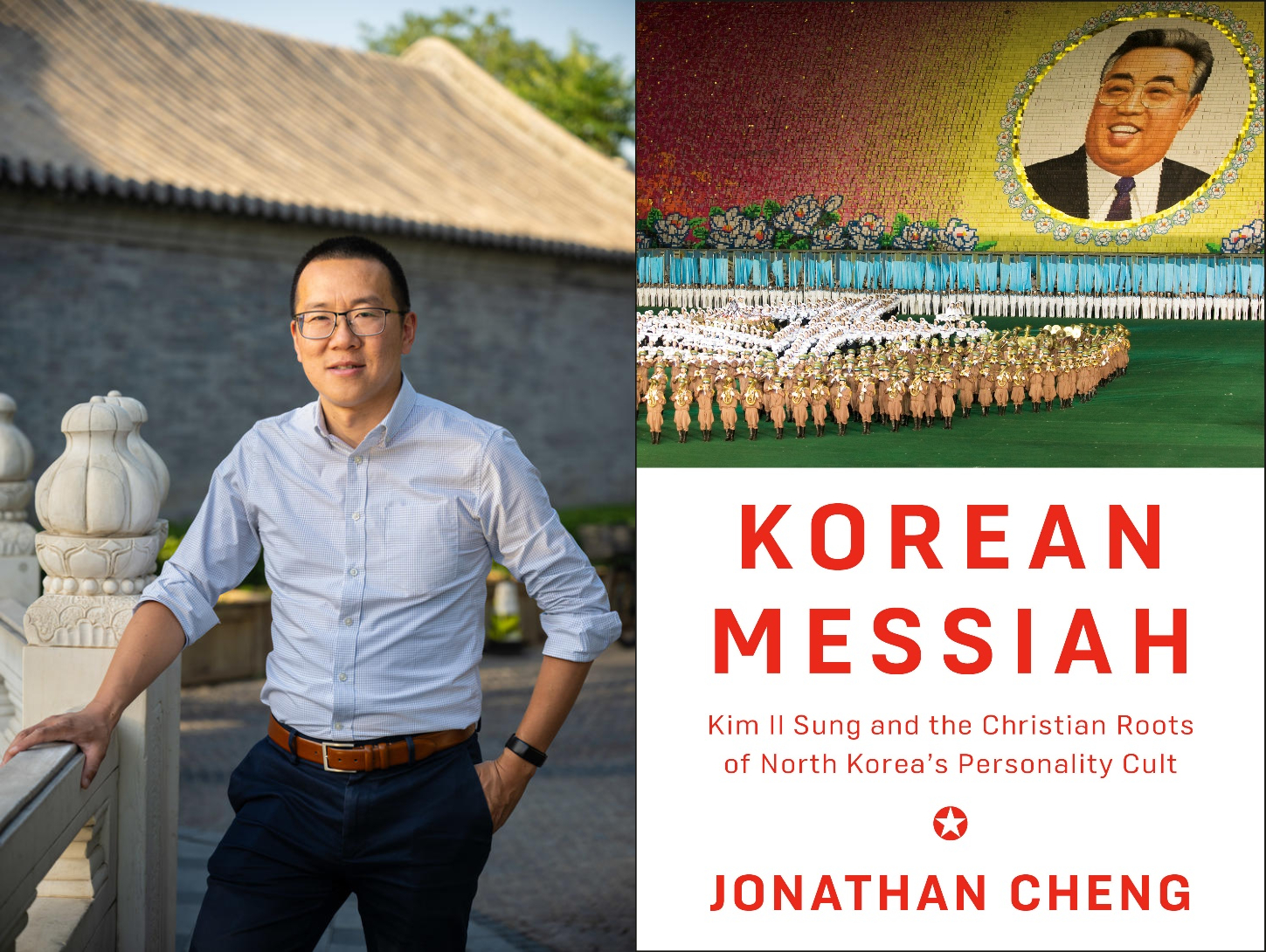
Author of the forthcoming book talks about Kim Il-Sung’s Christian roots, and what he uncovered from rare archives and on-the-ground visits to the world’s most isolated and least understood country
By Majid Maqbool
Jonathan Cheng, the Wall Street Journal’s China bureau chief and former Korea bureau chief, graduated from Princeton University with a history degree and rose through WSJ’s ranks from Hong Kong intern to leading coverage of the Korean Peninsula. In between, he visited North Korea twice, in 2013 and 2017. His forthcoming book, Korean Messiah: Kim Il Sung and the Christian Roots of North Korea’s Personality Cult (Knopf, 2026), named “Foreign Policy’s Most Anticipated Book,” charts North Korea’s enigmatic history through the ruse of the Kim dynasty and its surprising roots in post–Civil War American Christian fervor. The book reveals Pyongyang’s past as the “Jerusalem of the East” and Kim Il Sung’s devout Christian parents as progenitors of a Christlike personality cult more religious than Stalin’s or Mao’s.
In an interview for Asia Sentinel, Cheng, whose reporting and multilingual expertise have explained for years Asia’s most opaque regimes, discusses his over-a-decade-long research journey into North Korea’s myths, drawing from travels, archives, and on-the-ground visits, challenging global myths about the Hermit Kingdom.
Cheng sees no contradiction in Kim Il Sung’s Christian upbringing and his regime’s harsh suppression of the faith, while arguing that Kim, raised by devoted Christian parents, recognized religion’s power as both a threat and a control mechanism. The author also shares some book recommendations that provide deeper insights into the dynastic idolatry.
Edited excerpts:
In Korean Messiah, you detail how hagiographical accounts elevate North Korea’s ‘forever president’ Kim Il Sung to near-divine status. What primary textual sources and often-overlooked books were most useful in researching the origins of this personality cult?
In trying to pierce the veil of hagiography, it’s perhaps ironic that one of my most important sources was Kim Il Sung’s own memoir, published by North Korea in eight volumes starting in 1992. Most scholars will, correctly, dismiss the memoirs as fiction—but that doesn’t mean they aren’t of value. I’d venture to say that, while most of volumes two through eight are indeed fictionalized to the point of questionable value, the first volume is quite different: It covers the first eighteen years of his life, and it goes into great detail about his Christian upbringing—details that could only have come from Kim himself. And he offers us these incredible anecdotes where you can almost see the lightbulb going on in his head about the power of faith and the merits of play-acting as a messianic figure—letting people believe the myths around you—that he parlayed to such great effect during his half-century in power.
Kim Il Sung’s parents were devoted Christians, yet he founded the world’s harshest persecutor of the faith. From your WSJ reporting and North Korea travels, what fresh insights explain this striking family contradiction of Christian roots vs. anti-Christian persecution?
I don’t see a contradiction between his Christian roots and his persecution of Christians. Kim Il Sung grew up steeped in the faith and he appreciated its power—both as a threat to his rule and as an instrument of control, if only he could harness it. The most striking contradiction I see, if any, is how he tried to reconcile himself to the faith toward the end of his life. As he grew nostalgic, I believe he tried, however clumsily, to atone for what he had done. Readers may disagree with my interpretation, but I came away with the sense that, on some level, he grasped the horrors of what he had done—not that that absolves him of what he created.
In Korean Messiah, you uncover Kim Il Sung’s Christian family roots and their influence on the state’s idolatrous personality cult which seems to be largely overlooked in prior scholarship. Why has there been so little scholarship exploring how this background shaped the regime he led for nearly half a century, and how does your book fill that gap?
I don’t want to suggest that I’m the first to draw a line between Kim Il Sung’s Christian upbringing and the personality cult that he built. But I’m not sure anyone has gone quite as deep in exploring this connection. Why? One explanation I’ve heard is that in South Korea and among the Korean diaspora, where there is no shortage of scholars, many Christians with family roots in northern Korea, Kim Il Sung’s Christian upbringing is an uncomfortable reality. It complicates the Cold War-era understanding of Kim Il Sung as the persecutor of Christianity. That’s more of a blind spot on Korea’s political right. On the political left, the idea that religiosity, and American missionary teachings in particular, are so deeply woven into this nominally atheistic, anti-imperialistic state is difficult to swallow. So perhaps it was easier for someone like me to pursue this—I’m not of Korean heritage, and while I was raised in a church environment very much like Kim Il Sung, I’m able to look at it from a remove.
You note your years of struggling to master the Korean language. How did this linguistic challenge impact your research for Korean Messiah, particularly when navigating North Korean archives, conducting interviews, or accessing primary sources?
Language was a challenge in general. The primary sources for this topic are in Korean, Japanese, Russian, and Chinese, and very few people can dig into all these sources without some assistance. Helpfully, the North Koreans translated so much of their publications into English. But really, the secret of tackling a project like this is to assemble a team of research assistants. I worked with many over the twelve years I researched this book, and I couldn’t have done it without them.
You visited North Korea twice—in 2013 and 2017—as WSJ Korea bureau chief. What were some of your on-the-ground observations and findings from those trips that contradict the world’s perceptions of daily life in what you describe as the world’s most isolated and least understood country?
I don’t know that these contradict global perceptions of the country, but I’d point to two broad takeaways: Firstly, North Korea is a country full of real people who had as little choice about where they were born as you or I did. Secondly, I had to see it to believe that there really is a country like this. Before you go, you see the photographs and videos, but being there and seeing it all in real life—Kim on the walls, Kim on the lapel badges, Kim on the street corners, Kim on the front page, Kim on everyone’s tongue…You have to be there to grasp its magnitude.
Did your visits to North Korea challenge or complement your archival research in Korean Messiah, particularly with regard to Christian influences and personality cult myths surrounding the Kim dynasty?
By my second trip, I was already deep into researching the book. So, when our hosts asked what we wanted to see, I requested a church worship service—and to my surprise, they took us to Pyongyang’s two Protestant churches on Sunday morning. The one thing that stuck with me was the ubiquitous Kim portraits and lapel badges were nowhere to be seen. When I asked, I was told that those attending church were exempt—as if to suggest that Kim Il Sung recognized that, in this sacred space, there was only room for one deity.
In researching Korean Messiah, what were some previously not accessed letters, diaries, or archival materials that offered new insights or reshaped your view on the Kim family’s Christian ties and how they fuelled the regime’s religious-style personality cult?
I’ll give one example: North Korea published a book-length biography of Kim Il Sung’s distant uncle, Rev. Kang Yang-uk. Rev. Kang is an almost entirely overlooked figure in North Korean history. He was Kim Il Sung’s elementary school teacher and was preaching as a popular revivalist pastor when Kim Il Sung returned to Pyongyang in 1945. Kim elevated Rev. Kang to one of the most senior positions in North Korea’s government, where he remained until his death in the 1980s. Rev. Kang was effectively charged with bringing the church to heel, and he did it with ruthlessness. Very few people are aware that this hagiographical account of Rev. Kang even exists, but it proved invaluable. Relatedly, it’s remarkable to see Rev. Kang, appearing in the pages of North Korea’s official party newspaper, quoting from the Book of Isaiah to hail Kim Il Sung as the Korean Messiah. There were many such revelations over the twelve years I researched this book.
For readers of Korean Messiah, if you have to recommend three or four more books on Korean dynastic history, cult-making figures, and missionary influences, which books would you recommend that can also complement your account, and why?
I’m glad you asked. Firstly, my uncontroversial suggestion for anyone unfamiliar with North Korea is to start with Barbara Demick’s stunning Nothing to Envy (2009). It’s primarily about the famine of the 1990s but uses that as an entry point to talk more broadly about the country.
I’d add two works by Richard E. Kim, who was the grandson of a pastor and the son of two devout Christians. He was born in 1932 and lived through much of this history. His Lost Names: Scenes from a Korean Boyhood (1970) is what I might call “autobiographical fiction.” It’s incredibly evocative of the Japanese colonial period and captures the feelings of nationalism and shame that animated Kim Il Sung.
Richard Kim’s The Martyred (1964) is a novel set in Korean War-era Pyongyang. It’s a splendid read that lays out the moral stakes of faith, nationalism, guilt, and all the big themes that sit at the heart of my book.
And finally, for something beyond Korea, I’d add A Thousand Lives: The Untold Story of Jonestown, by Julia Scheeres. Jim Jones actually did have some Korean connections, which I mention in my book—he adopted several Korean children, praised Kim Il Sung over the loudspeakers in Guyana, sent his team to meet with North Korean officials, and even considered relocating Jonestown to Pyongyang.
But I recommend A Thousand Lives simply because it’s an accessible entry point into perhaps the most unsettling episode involving a religious society in recent memory, and deals with so many of the quirks and frailties of the human condition that allow personality cults to take hold.
Originally posted on Asia Sentinel.