The story of KOREAN MESSIAH begins—and ends—not with Kim Il Sung but with another man whose life was intertwined with Korea’s story.
His name is Billy Graham, and by the time he landed in Pyongyang on March 31, 1992, the North Carolina native was the world’s best-known Christian preacher. Rev. Graham had prayed with every U.S. president from Harry Truman to Barack Obama. He was a regular fixture on the cover of Time magazine and counted Martin Luther King, Jr., and Johnny Cash among his friends.
Graham, then seventy-three, had spent his life taking his globe-spanning “crusades” to stadiums around the world, including in Moscow, Warsaw, and elsewhere behind the Iron Curtain.
But North Korea was different. For Rev. Graham, it was personal.
As a young preacher, one of Graham’s first overseas tours was to South Korea in 1952, during the Korean War. Over the decades, Graham came back again and again, preaching before more than a million people in Seoul in 1973. Graham hailed South Korea’s spectacular rise as a global center of Christendom—the world’s second-largest sender of missionaries after the U.S., and home to the world’s largest megachurches (and some of the world’s best-known heterodox Christian movements, though Graham didn’t mention that).
But Graham always kept his eyes cast north of the thirty-eighth parallel. His wife, Ruth Bell Graham, the daughter of Presbyterian missionaries to China, had attended high school in Pyongyang in the 1930s, when the city was known as the “Jerusalem of the East”—the most thoroughly Christianized city in all of Asia.
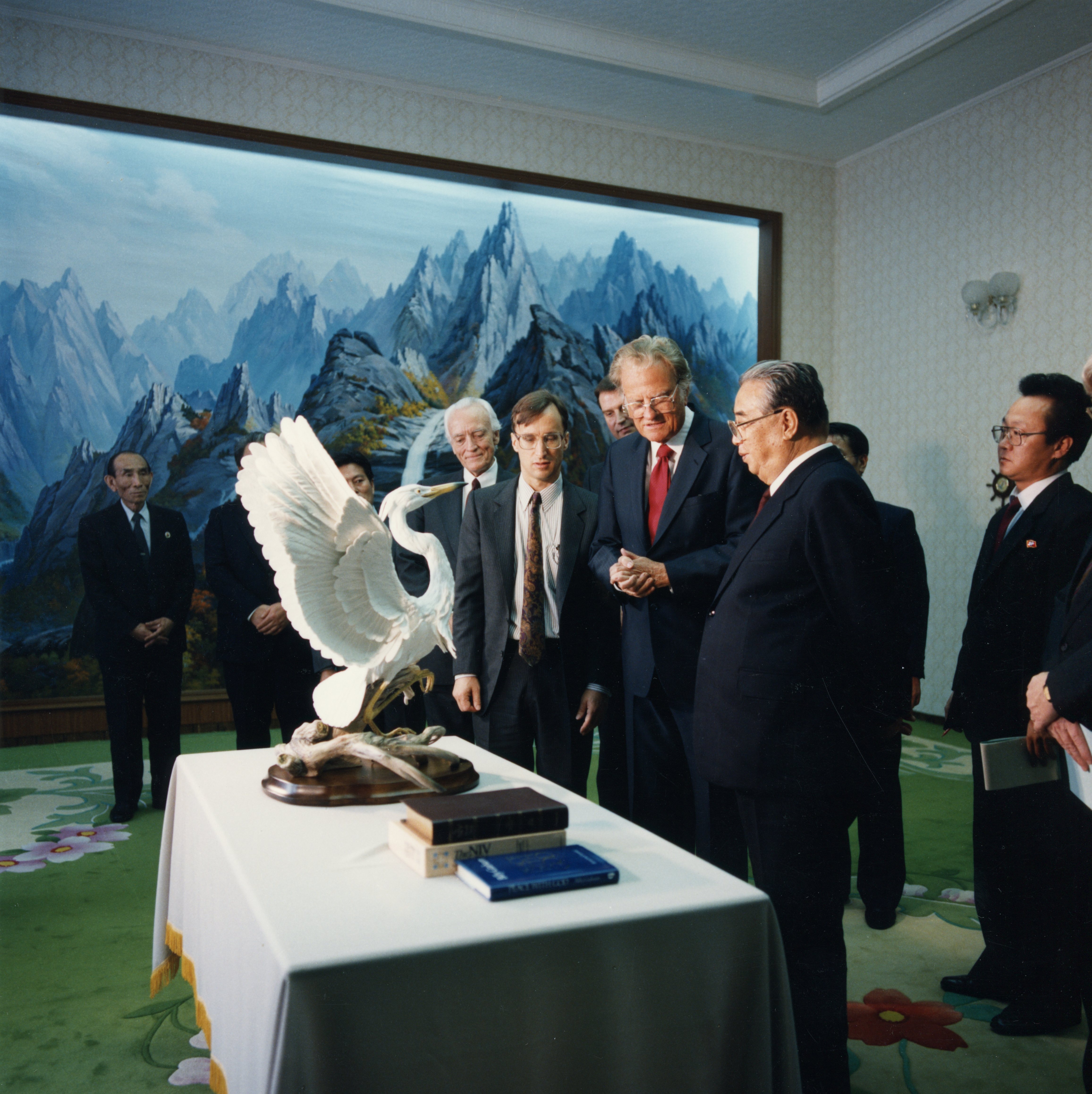
When Graham stepped off the plane in Pyongyang in March 1992, he was greeted “in the name of Jesus Christ” by the head of North Korea’s state-backed Christian federation, and whisked away to the birthplace of Kim Il Sung, just outside Pyongyang, where he was so struck by the humble thatched-roof hut that he quipped: “All they’re missing are the manger and the three wise men.”
Graham preached in Pyongyang’s two Protestant churches, which Kim Il Sung had only recently had constructed—including one at the birthplace of his mother, a devout “Bible-woman.” There, Graham preached his favorite passage, John 3:16: “For God so loved the world, that he gave his only begotten Son…” For the North Korean leader, Graham left behind a Bible and a copy of his 1953 book, Peace with God.
When Graham returned to Pyongyang in January 1994, the preacher implored the North Korean leader to remember the faith of his childhood—a faith, he noted, Kim’s own mother had professed.
Kim responded by regaling Graham with memories of attending church with his mother and of a pastor who had left a deep impression on him as a boy. “Some of his early experiences may be influencing him now,” Graham told The Wall Street Journal two days after departing Pyongyang.
In his own memoir, Graham offered another take: “I could not help but feel that in his heart he wanted peace with his adversaries before he died.”
Also posted on LinkedIn.